

We all love a bright, sunny day! Or do we?
If you suffer from photosensitivity, a chronic health condition, bright sunlight or even normal indoor lighting can cause skin reactions like rashes, burning sensations and itching. And that’s on top of the headaches, fatigue, isolation and mental health repercussions linked to the avoidance of light, affecting almost every aspect of normal life.
Dr Ewan Eadie, Head of Scientific Services at the Photobiology Unit of NHS Tayside, is all too familiar with the day-to-day challenges faced by children and adults suffering from various forms of photosensitivity.
As well as diagnosing conditions, the specialist team in Dundee supports patients in managing their lifelong illnesses, particularly given the limited treatment options available.
Dr Eadie explained, “Our department diagnoses light sensitivity conditions and advises on protective measures. However, over the years, we have become aware of a critical gap: we cannot currently provide patients with real-time insight into their daily light exposure or predict when symptoms might be triggered. Empowering patients to take a proactive role in managing their condition would be highly beneficial, especially with so few treatments currently available.
So what might help?
Alongside his colleagues, Dr Eadie sought to create a bespoke version of an existing app - ExpoDose - a smart environmental exposure detector developed by siHealth Ltd. The app was designed to automatically assess personal sun exposure in everyday life, primarily for self-monitoring or supporting research studies.
He added, “I proposed that we repurpose the ExpoDose app for patients with photosensitivity, providing a potential tool for them to monitor their exposure and make informed decisions about outdoor activity. The APPETISER project would explore whether ExpoDose was usable, reliable, and genuinely useful for people living with photosensitivity.”
Requiring financial support to fund the licensing implications of this work, Dr Eadie approached the Dragons’ Den to take the idea forward.
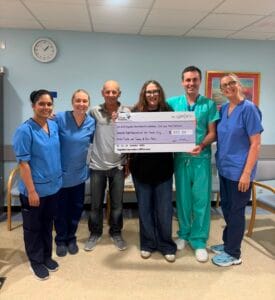
Impressing the Dragons with his presentation, Dr Eadie was awarded just over £17,000 by the NHS Tayside Charitable Foundation, and got working on the adaptations to the app alongside its developers.
Dr Eadie continued, “Working closely with our team, siHealth began to tailor the app to our needs. The inclusion of three distinct metrics, informed by our expertise and patient feedback, was a significant improvement over the standard version, allowing for more nuanced tracking relevant to different photosensitivity profiles.”
So, what did the patients think?
A pilot with existing patients showed that the app was stable on newer smartphones and easy to navigate. Usability improved over time, with 100% of participants finding it easy to use by the final questionnaire (up from 55%).
Technically, the app performed well after early issues were fixed, though some users reported occasional indoor/outdoor detection errors and data gaps in low-coverage areas.
But the most encouraging results came from patient feedback:
- 89% used the app daily
- 78% were satisfied with its performance (more than double the early satisfaction rate)
- 67% reported better management of photosensitivity
Participants reported greater awareness of UV levels, more informed decisions about sun exposure, and increased confidence when outdoors:
- “It has made me realise how much UV there is when it doesn’t seem sunny”
- “Given me a bit more confidence in going out in the sun”
- “Use of the app has made me much more alert to need for skin protection routine. UV value readings particularly useful early morning, at evening and in cloudy weather”
- “I can check the uv numbers and learnt how to gauge at what numbers I
will start to react” - “Given me a bit more confidence going out when it is sunny”